
Table of Contents
Behind Theyr’s voyage optimisation technology is a team bringing together maritime experience, scientific expertise and a practical understanding of how decisions are made at sea.
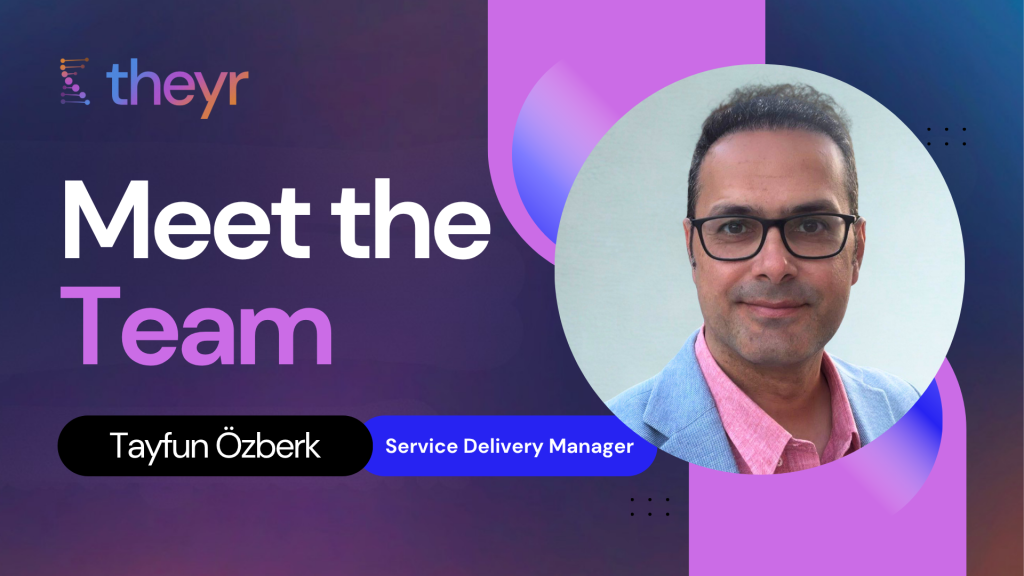
In this Meet the Team profile, we speak with Tayfun Özberk, Service Delivery Manager at Theyr, whose background spans 16 years in the Turkish Navy, naval analysis, electronic warfare and maritime technology. His role sits at the point where customer needs, operational realities and product development meet.
Tayfun explains what drew him to Theyr, how his naval experience informs his approach to service delivery, why agility matters in maritime technology, and which developments in the naval and defence space continue to shape his thinking.
Having spent 16 years in the Navy, what drew you to Theyr, and what made it feel like the right place to apply your hands-on experience?
After 16 years in the Turkish Navy, including 12 on board warships, I had spent my career making split-second decisions in some of the most challenging maritime environments imaginable. I specialised in above-water warfare, particularly in littoral waters, serving on frigates and fast attack craft. I took part in numerous NATO and UN missions, earned two NATO medals, and completed operational electronic warfare training at a NATO school.
But here is what I learned: the best operational decisions are the ones informed by the best data, analysed in the most efficient way possible.
That is what drew me to Theyr. When I first learned about the company, I saw something rare: a technology business that was not just talking about optimisation in abstract terms, but actually deliveringmeasurable results through T.VOS. Ships burning less fuel, shorter voyage times, reduced emissions: these are not just metrics, they are real operational improvements that matter.
What really sealed it for me was Theyr’s involvement in DARPA’s NOMARS project and the potential to apply voyage optimisation to both manned and unmanned naval platforms. I realised that my operational experience, understanding how vessels perform in real-world conditions, what commanders need in order to make decisions, and how endurance and efficiency translate into operational capability, could directly help make these technologies better.
The company was not looking for someone who only understood technology, or only understood naval operations. They needed someone who could bridge both worlds. That is exactly where I live.
Having completed two programmes at the Turkish Naval Academy (naval officer and computer engineer) I have always been comfortable at the intersection of maritime operations and IT. Theyr felt like coming home, just with a different mission set.
What does agility look like inside Theyr day to day, and why does that matter to customers?
As Service Delivery Manager, I see agility play out every day in how we respond to clients. In the Navy, we had a saying: no plan survives first contact. The same is true in technology. No matter how good your solution is, real-world deployment brings unexpected challenges.
At Theyr, agility means we do not hide behind bureaucracy or rigid processes when a client has a problem. I run our Jira service desk, and part of my job is to be the bridge between clients and our development team. When an issue comes in, we do not just log it and forget it. We assess, prioritise and act. Sometimes that means I am on a call with a client in the morning, discussing their specific operational context, and by the afternoon I am working with our developers to adapt the solution.
This matters enormously because maritime operations do not wait. A vessel at sea cannot afford downtime, and commercial operators work to tight margins. When they raise a concern, they need to know that someone understands the urgency and has both the technical knowledge and the operational awareness to help quickly.
That same agility shapes how T.VOS evolves. My naval background helps here because I can translate what a client is experiencing operationally into technical requirements the development team can work with. We are not just selling software; we are continuously improving a solution that operates in one of the most complex, dynamic environments on earth.
A few weeks on from CNE, what maritime or naval technology developments are you watching most closely right now?
CNE is always one of my favourite events of the year. It is refined, B2B-focused, and you get real conversations with naval professionals rather than just marketing pitches. This year, I have been watching several developments closely.
First, the continued evolution of autonomous and unmanned surface vessels. Having worked on DARPA’s NOMARS project, I have seen first-hand both the potential and the challenges. The technology is maturing rapidly, but the real question is not simply whether we can make ships autonomous. It is whether we can make them operationally effective, reliable, and integrated into existing naval architectures. Voyage optimisation and strategic planning for USVs is not just about navigation; it is about mission effectiveness and endurance in contested environments.
Second, I am very interested in developments around electronic warfare and sensor fusion in the maritime domain. My operational EW training at NATO school taught me that the electromagnetic spectrum is a critical battlespace, and with the proliferation of sensors, communications and weapons systems, managing that spectrum effectively is more important than ever. How navies integrate EW capabilities with AI-driven decision-support tools will be crucial.
Third, and this connects directly to what we do at Theyr, is the growing focus on operational efficiency and sustainability in naval operations. Fuel efficiency is not just an environmental issue; it is an operational capability multiplier. Longer endurance means extended patrol times, greater operational reach, and reduced logistics footprints. The technologies that help navies do more with less will become increasingly valuable, particularly as defence budgets face pressure and operational tempos remain high.
Outside work, what keeps you curious and learning?
I have a philosophy: either you learn or you win. Ideally, both. I am a lifelong learner, and that mindset has served me well throughout my career.
Beyond my day job at Theyr, I work as a freelance naval analyst, writing analysis and articles for defence media platforms in the UK, US, France, Pakistan and Germany. I focus on naval warfare, unmanned systems, and emerging conflicts from a maritime perspective. I also appear as a subject-matter expert on outlets such as CNN International, BBC World and Al Jazeera. Last year, I was honoured to be nominated as a finalist in two categories at the Defence Media Awards – Best Naval Submission and Best Electronic Warfare Submission. It is sometimes called the “Oscars of defence media”, so that recognition meant a great deal.
That analyst work keeps me closely engaged with current events and forces me to think critically about how warfare is evolving. It is not just about understanding the technology; it is about understanding the strategic, operational and tactical implications.
Outside the professional sphere, I am a music lover. I have been playing electric guitar since my university days, we had a band back then, and I still miss those times. There is something about music that is both creative and disciplined, not unlike naval operations in a way.
I am also a table tennis enthusiast. I played professionally for nine years, competed in numerous tournaments, and won medals. These days I play as an amateur when I can, but the competitive spirit never really leaves you. Table tennis taught me about reflexes, strategy and staying calm under pressure, skills that translate surprisingly well to both naval operations and client management.
And of course, I am always reading. History is a particular passion of mine. Understanding how decisions were made in the past, what worked and what did not, helps inform how we think about the present and the future. Whether it is naval history, military strategy or broader geopolitical trends, there is always something new to learn.
For Tayfun, maritime technology is most valuable when it is grounded in operational reality. Better data, smarter algorithms and more efficient systems only make a difference when they help people make clearer decisions in complex environments.
That perspective is central to Theyr’s work: combining science and software with the experience needed to apply them in the real world. From commercial vessels to emerging naval platforms, the aim is not only to optimise routes, but to support better, faster and more trusted decision-making at sea.