
Table of Contents
Operators in shipping use a charter party compliance checklist to make sure voyage execution stays aligned with the charter party agreement from fixture to final close-out. A strong checklist covers speed and consumption clauses, ETA notices, weather-performance treatment, bunker use, Notice of Readiness, laytime evidence and the records needed to prevent or defend claims.
Most charter party losses do not come from one dramatic breach. They come from small variances that are not captured early enough: the wrong ballast or laden assumption, an ETA that drifts without notice, weak weather evidence, a route change with no commercial record, or an NOR tendered incorrectly.
What is charter party compliance in shipping?
In shipping, a charter party, sometimes written charterparty, is the contract that sets out the commercial obligations between owner and charterer. Charter party compliance means executing the voyage in line with those terms and preserving the evidence needed to prove that performance.
That makes charter party compliance more than a legal review. It is an operating discipline that affects route choice, speed, fuel burn, ETA control, weather treatment, notices, port events, and claims prevention.
Traditional charter party compliance is often retrospective. Teams collect logs after the voyage, then try to explain fuel overruns, speed underperformance, weather exclusions, or laytime disputes once the commercial position is already hardening.
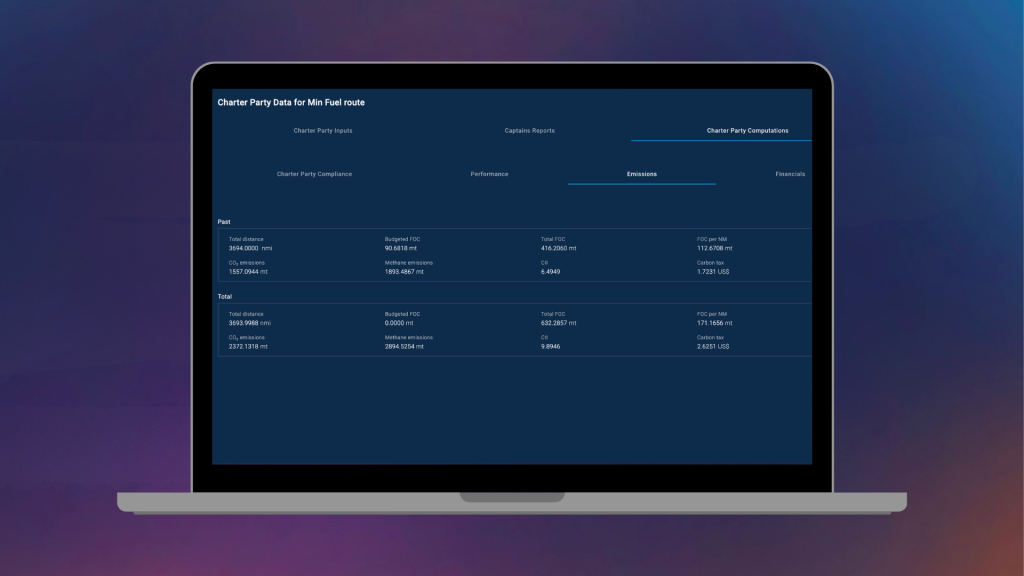
The better operating model is continuous. T.VOS is built around that idea: monitoring fuel, time, and emissions against contracted terms, assessing weather-related exclusions, and projecting likely end-of-voyage outcomes as actual vessel data and forecast conditions change during transit. That is the mindset behind the checklist below.
The checklist at a glance
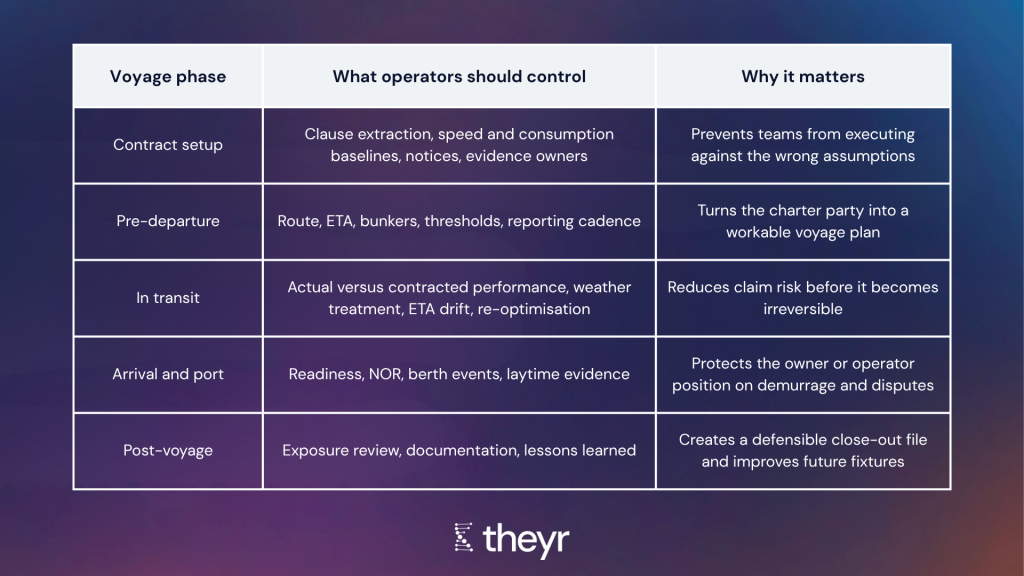
Charter party compliance checklist for operators
1. Confirm the charter type, form and order of precedence
Before the vessel sails, confirm whether the voyage is governed by a voyage charter, time charter, sub-charter, or COA, and which documents govern if there is a conflict. The recap, printed form, rider clauses, addenda, and voyage instructions must point to one operational truth.
2. Translate the charter party agreement into operational fields
Do not leave key obligations trapped in PDFs or email chains. Convert the contract into working fields your operators can follow: speed, consumption, notice windows, laycan, NOR rules, weather exclusions, laytime triggers, demurrage exposure, and any environmental performance obligations.
3. Enter speed warranties exactly as agreed
Capture the contractual speed terms without simplifying them away. Separate ballast and laden conditions, good-weather performance, draft assumptions, and any special wording tied to currents or sea state. Many disputes begin because teams operate from a generic speed number rather than the agreed clause.
4. Enter consumption warranties exactly as agreed
Do the same for fuel consumption. If the charter party distinguishes ballast versus laden consumption, different speeds, weather-based adjustments, or other operating conditions, those distinctions must be reflected in the voyage controls from the start.
5. Map every notice, update and recipient
List every required ETA notice, rolling update, cargo notice, or delay notification. Record who must receive it, when it must be sent, what format is required, and what proof must be retained.
6. Assign evidence owners and escalation thresholds
Decide who owns noon reports, weather data, ROB data, engine or performance logs, NOR, Statement of Facts, protest letters, and agent communications. Also decide when operations, claims, and commercial teams must be alerted.
7. Build the route against the charter party, not just the shortest passage
The best route on fuel is not always the best route commercially. Voyage planning should reflect laycan, berth windows, speed and consumption clauses, likely weather exposure, deviation limits, and any counterparty instructions already on the table.
8. Compare shipowner and charterer priorities before departure
Some voyages favour lower bunker burn and lower penalty risk. Others favour faster cargo delivery and earlier availability. Operators should understand both perspectives before committing to a plan, because what is commercially optimal for the owner may not be optimal for the charterer.
9. Validate ETA against laycan, berth readiness, and cargo availability
A good ETA is not only technically plausible. It must also be commercially defensible. Check the ETA against the laycan window, berth congestion, terminal restrictions, cargo readiness, and any notice obligations that depend on expected arrival.
10. Stress-test the voyage under realistic weather and ocean conditions
Weather should not be only a routing input. It should also be a compliance input. Test what happens to arrival time, speed, and consumption if headwinds strengthen, currents shift, or the vessel encounters poor conditions for longer than expected.
11. Set live thresholds for drift before the vessel sails
Define the triggers that should force action: ETA slippage, underperformance against speed, overconsumption, missed notices, environmental exposure, or unusual weather-related exceptions. The best checklist tells the team when to intervene, not only what to document.
12. Monitor actual versus contracted speed during the voyage
Track vessel performance against the charter party baseline, not just against the internal voyage plan. The earlier speed drift becomes visible, the more room operators have to mitigate.
13. Monitor actual versus contracted fuel consumption during the voyage
Do not wait until arrival to see whether consumption is off track. Watch daily or voyage-leg performance against the agreed clause, keeping ballast, laden, and speed-dependent assumptions distinct.
14. Separate sea time from port time
Performance analysis becomes unreliable when port delay contaminates sea-passage assessment. Keep a clean distinction between sea time and port time so the team can assess the voyage fairly and defend the record later.
15. Distinguish good-weather from bad-weather performance
This is one of the most commercially sensitive parts of charter party compliance. Operators need a clear record of which conditions support a performance claim and which conditions are excluded. Good weather and bad weather should not be blended into one vague average.
16. Keep an updated projected end-of-voyage view
Operators need to know where the voyage is likely to finish against charter terms, not just where it stands today. Re-forecast compliance whenever actual vessel performance or forecast conditions change materially. In a solution like T.VOS, that view is refreshed continuously during transit rather than left for a post-voyage reconstruction.
17. Re-optimise when the voyage trends toward a claim or penalty
If the vessel is trending toward a speed claim, fuel penalty, missed window, or growing commercial exposure, compare alternative routes or speed profiles while recovery is still possible. This is where voyage optimisation and charter party compliance become inseparable.
18. Log ETA updates and charterer instructions with timestamps
Every ETA change, waiting order, speed instruction, port change, or other commercial direction should be timestamped and retained. Unlogged instructions are difficult to defend later, especially when responsibility becomes disputed.
19. Track emissions and environmental clauses where relevant
Where charter parties include environmental performance expectations, or where emissions exposure affects the commercial outcome, operators should monitor those obligations alongside speed, fuel, and time rather than in a separate workflow.
20. Confirm physical and legal readiness before arrival-related notices
Before any arrival-related notice is issued, confirm the vessel can satisfy the readiness standard required by the charter party. That may include document readiness, free pratique or equivalent formalities, and cargo-space or tank readiness where relevant.
21. Tender Notice of Readiness correctly
Tender NOR to the correct party, in the correct form, and at the correct time. A technically defective NOR can create avoidable laytime and demurrage exposure even when the vessel is otherwise ready.
22. Capture berth delays, waiting time, and cargo interruptions in real time
Anchorage waiting, berth congestion, shifting, weather stoppages, loading or discharge delays, and shore-side interruptions should be recorded as they happen. Do not rely on memory after the port call.
23. Reconcile the Statement of Facts and laytime events while the call is still current
Compare the Statement of Facts against vessel logs, operator records, agent messages, and cargo events while supporting evidence is still easy to retrieve. Real-time reconciliation is far cheaper than retrospective argument.
24. Compare actual versus projected end-of-voyage outcome and quantify exposure
Once the voyage is complete, compare the actual result to the latest projected end-of-voyage view. Quantify the fuel, time, hire, laytime, demurrage, or claims exposure while the facts are still fresh.
25. Archive the evidence and feed it into future negotiations
A completed voyage should create a reusable record. Preserve the full evidence file and use it to improve future forecasting, fixture negotiations, clause setting, and operator decision-making on similar routes.
Why operators need one workflow for voyage optimisation and charter party compliance
Operators get into trouble when routing, performance analysis, weather treatment, and claims evidence live in separate tools. A solution like T.VOS closes that gap by using the same vessel and ocean data for planning and compliance, monitoring actual-versus-contracted fuel and time performance, distinguishing good-weather and bad-weather periods, projecting likely end-of-voyage exposure during transit, and surfacing alerts before a variance becomes a claim. The same approach also supports owner-optimised and charterer-optimised route comparisons, so teams can see the trade-off between bunker savings, ETA, and contractual exposure before making a decision.
What operators should expect from a voyage optimisation solution
A modern voyage optimisation solution should monitor actual versus contracted performance during the voyage, not just after the voyage. Additionally, it should show route, fuel, time, emissions and commercial outcomes together so operators do not have to choose between operational efficiency and compliance discipline.
Conclusion
The best charter party compliance checklist is not a static document. It is a live operating framework that starts before departure, evolves during transit, and closes with a clean evidence file.
For operators, that means three things: translate the charter party agreement into actionable controls, monitor the voyage against those controls in real time, and use the completed voyage to improve the next one.
That is also where T.VOS should be positioned: not as a separate claims tool, but as the workflow that helps operators compare route choices, monitor actual-versus-contracted performance, assess weather impact, and manage likely commercial outcomes before a dispute appears.
Frequently Asked Questions (FAQs)
What is charter party compliance?
Charter party compliance is the process of executing a voyage in line with the charter party agreement and preserving the evidence needed to prove performance. For operators, that usually includes speed and consumption monitoring, ETA notices, weather treatment, NOR, laytime records and post-voyage reconciliation.
What is the biggest charter party compliance mistake operators make?
Treating compliance as a legal review at the end of the voyage instead of an operating workflow during the voyage. By the time the team starts reconstructing the record, the best opportunities to reduce exposure are often gone.
How do good-weather and bad-weather periods affect performance claims?
Many charter parties allow certain weather conditions to be excluded when assessing speed and consumption performance. That is why operators need a clean, contemporaneous weather record and a consistent method for deciding which periods count and which do not.
What should a daily charter party compliance dashboard show?
At minimum, operators should be able to see actual versus contracted speed, actual versus contracted consumption, ETA variance, sea time versus port time, weather classification, key notices sent and a projected end-of-voyage commercial position.
Why is projected end-of-voyage compliance useful?
Because it gives operators time to act. A projected end-of-voyage view helps teams identify whether they are trending toward a claim, penalty, missed window, or performance dispute while alternative routing or speed decisions are still available.
Should charter party compliance be separate from voyage optimisation?
Not ideally. In practice, the same decisions that affect route efficiency also affect contract compliance. T.VOS is positioned on the principle that charter party compliance should sit inside the voyage optimisation workflow, alongside fuel, time, emissions, and commercial outcomes, rather than in a separate after-the-fact claims process.