
Table of Contents
In an era of rising fuel costs, strict emissions rules and hard-fought charter agreements, shipowners and operators can no longer afford to treat voyage optimisation as merely a weather routing exercise. It has evolved into a multi-dimensional challenge that must embed charter party compliance into every routing decision. Traditional voyage plans often focus on weather and fuel, leaving charter terms as an afterthought checked only post-voyage.
Theyr’s T.VOS platform embodies this shift. Powered by an AI-driven multi-objective optimisation engine, T.VOS goes beyond plotting safe routes; it continuously balances fuel efficiency, arrival times, emissions and contractual commitments simultaneously. A cornerstone of this capability is the new Dynamic Charter Party Module, developed with chartering experts Rensmarine, which brings charter party compliance calculations directly into the optimisation process. In this post, we explore how real-time, predictive voyage optimisation with T.VOS enhances charter party compliance. And why it’s a game-changer for maritime technology vendors and forward-thinking shipowners.
The high stakes of charter party compliance in real time
Charter party agreements set strict performance terms: from guaranteed transit speeds and fuel consumption to laytime and arrival windows. Historically, compliance with these terms was assessed after the voyage, using noon reports and hindsight. If a ship underperformed due to weather or operational issues, commercial consequences like speed deficiency claims, extra fuel cost penalties, or disputes over weather allowances would emerge only during post-voyage analysis. By then, opportunities to influence the outcome have passed. The damage to profit and relationships is done. In today’s market, this reactive approach is untenable. Shipowners face thin margins and charterers demand transparency and reliability. A single missed performance clause can erode a voyage’s Time Charter Equivalent (TCE) earnings or lead to protracted legal disputes.
Real-time charter party compliance flips this script. Instead of hoping for the best and calculating losses later, operators can monitor and manage compliance as the voyage unfolds. Environmental regulations like the IMO’s Carbon Intensity Indicator (CII) are now creeping into charter parties in the form of emissions performance clauses and voyage rating requirements. A route that is fuel-efficient but causes a poor CII rating or a late arrival can trigger financial penalties or damaged reputation. The industry is recognizing that charter party compliance belongs inside voyage optimisation, not apart from it. To stay competitive and avoid costly claims, operators need tools that ensure every course change and engine order also considers its charter party implications.
T.VOS Dynamic Voyage Optimisation Charter Party module: predictive compliance by design
Theyr’s answer to this challenge is the T.VOS Dynamic Charter Party module, a breakthrough that embeds charter terms into the heart of voyage planning and execution. In practice, this means T.VOS isn’t just finding the fastest or most efficient route. It is finding the smartest route that respects the contract and maximises commercial outcomes. How does it work? The module translates your charter party clauses into computational logic and feeds them into T.VOS’s AI optimisation engine. When setting up a voyage, the operator inputs the key charter terms: warranted speed, fuel consumption limits, weather exclusions, laycan or latest arrival, bunker price and even bonus/penalty rates. The Dynamic CP Module’s algorithm then creates a dynamic model of the contract that evolves as the voyage progresses.
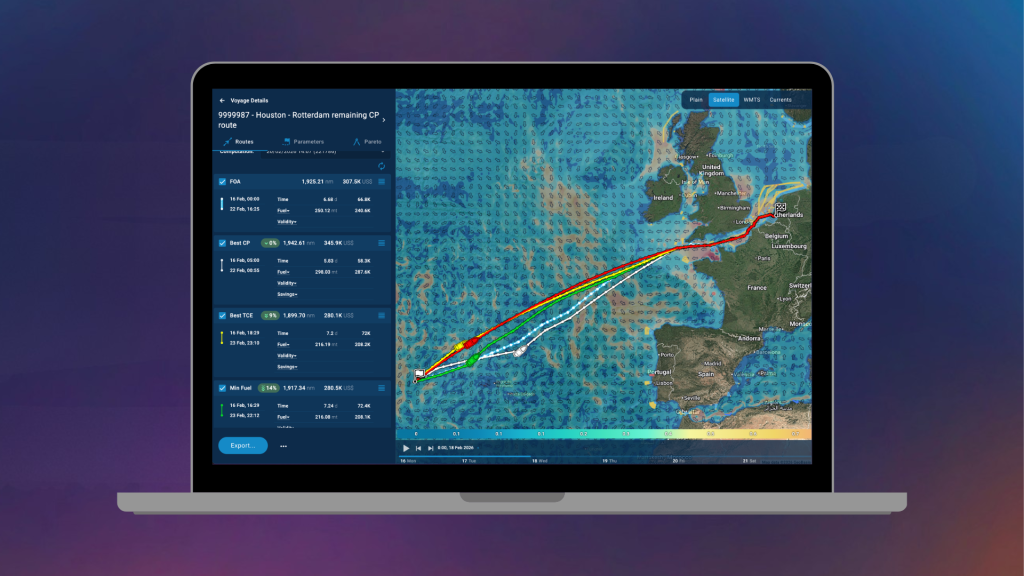
Before departure, T.VOS uses this model to evaluate hundreds of thousands of voyage options in parallel, each a potential route and speed profile. Crucially, for each option it simultaneously calculates the charter party compliance implications. By presenting routes side by side with their predicted contractual outcomes, T.VOS gives operators unprecedented foresight. For example, you can immediately see if a fuel-saving slow-steaming plan might fall below the charter’s speed warranty, or if a fast-track route would result in higher fuel cost but secure an early-delivery incentive. This allows for an informed decision on the optimal balance. In short, you can spot potential speed and consumption disputes before they happen and choose a route that best aligns with your commercial strategy.
Once the voyage is underway, T.VOS continuously ingests real-time data. The ship’s actual speed and consumption, observed weather, forecast changes and it re-optimises the route up to four times per day as conditions evolve. Each re-calculation updates the projected end-of-voyage performance against the charter party. If delays or bad weather threaten to make the vessel miss an ETA or exceed fuel limits, the system flags it and can suggest adjustments to bring the voyage back into compliance. Conversely, if the voyage is running better than expected (ahead of schedule or under budget on fuel), T.VOS identifies that “performance buffer” and offers choices: bank the savings (e.g. slow down to save more fuel) or use it to arrive earlier. Whatever makes more commercial sense. This predictive approach turns charter management from reactive damage control to proactive optimisation. Operators no longer have to wait for the voyage to end to know where they stand; T.VOS provides a “projected end of sea passage” view throughout the journey, showing exactly how the current trajectory measures up against the charter party terms.
Multi-objective optimisation: Balancing fuel, speed, emissions and charter terms
T.VOS’s optimisation engine is powered by advanced artificial intelligence and more specifically, a multi-objective Genetic Algorithm co-developed with leading researchers at the Alan Turing Institute and University of Southampton. This next-generation approach is a leap beyond the single-factor or weighted methods used in older voyage planning software. Instead of focusing on one goal (like minimising fuel) and treating others as constraints, T.VOS optimises for all key objectives simultaneously. The algorithm rapidly evolves a “population” of route candidates, evaluating each against multiple criteria such as fuel burn, travel time, safety limits, CII compliance and of course charter party metrics like performance clauses and cost of any deviations. Through hundreds of thousands of iterations, it converges on a Pareto-optimal set of routes that offer the best trade-offs.
T.VOS creates a set of optimal voyages that are all equal in terms of the objectives. The system effectively lets you view the voyage from both perspectives, with the charter party implications clearly quantified in each. This data-driven transparency can even serve as a neutral basis for owner-charterer negotiations during the voyage. In the end, multi-objective optimisation ensures that no single goal (whether it’s cost saving or timeliness) tramples the others; it finds balance.
Real-world scenarios: Dynamic voyage optimisation in action
To better understand the value of real-time charter party management, consider a few real-world scenarios:
- Ahead of schedule – optimise for TCE: A tanker on time charter finds itself running ahead of performance expectations thanks to favourable currents early in the voyage. As days at sea progress, T.VOS continually compares the vessel’s actual performance against the charter guarantees. It becomes clear that the ship will easily beat the speed warranty and could even arrive a day early. T.VOS Charter Party module shows that by reducing speed and switching to a more circuitous route with calmer weather, the ship can save an additional 5% in fuel while still meeting the contractual ETA. The system’s projections show that this would boost the voyage’s Time Charter Equivalent earnings by turning unused speed margin into fuel savings. Effectively monetising the vessel’s outperformance for the owner’s benefit. Because charter party compliance is continuously monitored, the owner can make this choice confidently, knowing it won’t violate any terms. The charterer, on the other hand, still gets their cargo on time and benefits from lower emissions due to reduced fuel burn. It’s a win-win scenario that only a predictive optimisation tool could reveal in advance.
- Environmental compliance and contracts: A container ship is navigating new CII regulations that require it to maintain a certain efficiency rating by year’s end. The charter party even stipulates that the ship should strive for a CII “C” rating or better on each voyage, with a clause that could penalise extreme non-compliance. T.VOS’s multi-objective algorithm accounts for this by including CII performance as a voyage objective next to speed and fuel. During one voyage, market pressures tempt the operator to speed up to make an earlier berth slot. Normally, higher speed means higher emissions and a worse CII. The Dynamic Charter Party module crunches the numbers and warns that pushing to maximum speed would likely downgrade the voyage’s CII rating from B to D, conflicting with the charter commitment. It suggests a middle ground: adjusting arrival to just-in-time rather than racing in, which keeps the CII impact within acceptable bounds while still meeting the cargo delivery window. The operator follows this guidance. The ship arrives just in time without a harmful rating drop, avoiding potential charter penalties and contributing to the company’s broader sustainability goals.
Conclusion: redefining voyage optimisation for a new era
The integration of real-time charter party compliance into voyage optimisation isn’t just an incremental improvement. It’s a transformative development for maritime operations. By ensuring that every route recommendation is contract-aware, Theyr’s T.VOS Dynamic Charter Party Module is redefining what it means to optimise a voyage. It bridges the traditional gap between the navigation team and the chartering desk, providing a single source of truth that both can trust. In doing so, it not only cuts fuel and emissions, but also cuts out uncertainty, friction and waste in the voyage lifecycle.
For maritime technology vendors, adopting or integrating the T.VOS solution means offering your users the next level of decision support. One that can future-proof their operations against regulatory shifts and market volatility. For shipowners and operators, it means peace of mind and competitive edge.
Ready to experience the difference? Contact us to book a demo of T.VOS and see first-hand how our Dynamic Charter Party Module can enhance your operations.