
Table of Contents
A vessel can save fuel and still miss the commercial objective. It can protect ETA while burning unnecessary bunkers. It can avoid heavy weather and still end up exposed on charter-party performance. That is why voyage optimisation matters. It sits in the middle of these competing pressures and helps teams make better decisions across the whole voyage, not just one part of it.
In practical terms, voyage optimisation is the process of selecting the most effective route, speed and operating profile for a vessel by balancing weather, fuel consumption, timing, safety, emissions and commercial constraints. It is not simply about plotting a more efficient line on a chart. It is about choosing the voyage plan that delivers the best overall operational and commercial outcome.
What is voyage optimisation in shipping?
Voyage optimisation in shipping is the discipline of finding the best overall way to execute a voyage once all the important variables are considered together.
That includes forecast weather, sea state, vessel performance, fuel burn, ETA, port timing, emissions exposure and contractual obligations. The aim is not to optimise one variable in isolation. It is to find the best possible balance between them.
That distinction matters. On a real operations desk, decisions are rarely as simple as “save fuel” or “arrive faster”. A vessel that slows excessively may reduce bunker consumption but create issues with berth windows, cargo readiness or charter-party compliance. A vessel that pushes too hard may protect schedule performance while increasing fuel costs, emissions exposure and operational risk. Effective voyage optimisation helps operators understand these trade-offs early enough to act on them.
Why voyage optimisation matters more now
Voyage optimisation has become more important because the commercial stakes are higher than they used to be.
Fuel remains one of the largest controllable voyage expenses, but it is no longer the only pressure shaping operational decisions. Emissions performance, carbon exposure, schedule reliability and contractual performance now all influence voyage economics directly.
That means poor voyage decisions carry wider consequences than they once did. There is also a planning dimension that is often underestimated. Voyage optimisation does not begin when the vessel sails. It starts much earlier, during voyage planning, fixture calculations and operational assumptions around fuel consumption, sea margin, transit time, TCE and arrival windows.
In that sense, voyage optimisation is not just an operational tool. It is also a planning and commercial decision framework.
Weather routing vs voyage optimisation
Weather routing and voyage optimisation are related, but they are not the same thing. Weather routing focuses primarily on safe and efficient navigation through forecast conditions. Voyage optimisation uses weather as one input among many. The broader question voyage optimisation asks is:
What is the best overall voyage plan once weather, vessel behaviour, fuel consumption, ETA, emissions and commercial constraints are considered together?
That broader perspective reflects the reality of modern shipping operations. A route that appears meteorologically efficient may still be commercially suboptimal if it creates excessive waiting time, poor ETA reliability or increased charter-party exposure.
Voyage optimisation therefore goes beyond route safety. It helps operators understand the operational and commercial consequences of each decision.
Fuel efficiency without losing the commercial picture
Fuel efficiency is still one of the clearest benefits of voyage optimisation, but it is also one of the most misunderstood. Good voyage optimisation is not simply about telling vessels to go slower. It is about choosing the right speed in the right place for the right commercial outcome.
On one voyage, the most sensible decision may be to ease down earlier and support just-in-time arrival, avoiding the familiar “sail fast, then wait” problem. On another, it may be worth maintaining speed to protect a berth slot, cargo schedule or contractual commitment. The lowest-fuel route is not always the best business route.
That is why shipping teams need more than a single recommendation. They need to understand how fuel efficiency interacts with voyage time, ETA reliability, emissions performance and charter-party terms. When those variables are assessed together, teams can choose a route that works not just operationally, but commercially as well.
ETA reliability matters more than an optimistic ETA
In most operations teams, the real value is not an ambitious ETA. It is a reliable one.
ETA reliability affects berth allocation, cargo readiness, bunkering, pilotage, downstream logistics and trust between ship and shore operations. A vessel arriving too early may spend unnecessary time waiting at anchor, increasing fuel burn and emissions without creating commercial value. A vessel arriving late can disrupt schedules, increase costs and damage service performance.
This is where voyage optimisation becomes especially valuable. A robust optimisation process should continuously reassess the voyage against updated weather, operational constraints and live vessel performance. It should identify whether the vessel can still maintain the required arrival window and what adjustments may improve the outcome.
That is considerably more effective than relying on a static ETA established at departure and hoping it remains achievable throughout the voyage.
Charter-party exposure is where the commercial value becomes clear
Fuel savings are easy to quantify. Charter-party exposure is often where the real commercial value appears.
Small variations in speed, fuel consumption, sea conditions and voyage duration can lead to significant claims, disputes or margin erosion once a voyage is assessed against charter-party terms.
These are familiar operational questions:
- Did the vessel maintain warranted speed in qualifying weather?
- Was excess consumption caused by genuine conditions or avoidable operational choices?
- Is the voyage still tracking within fixture assumptions?
Too often, these questions are only reviewed after voyage completion, when corrective decisions are no longer possible. Voyage optimisation changes that dynamic.
When charter-party terms are integrated into voyage planning and execution, operators gain visibility into potential commercial exposure before departure and throughout the voyage itself.
Guaranteed speed, contracted consumption, weather exclusions, financial clauses and likely end-of-voyage outcomes can all be evaluated alongside routing decisions. At that point, optimisation stops being purely operational and becomes part of day-to-day commercial risk management.
Where T.VOS fits
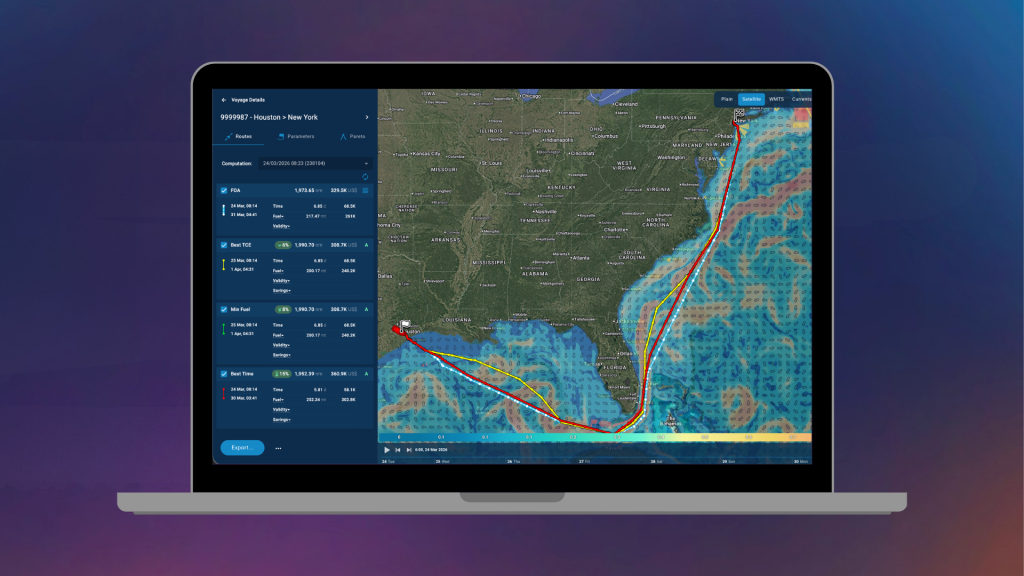
T.VOS is built for exactly this kind of decision-making. It is an API-first, multi-objective voyage optimisation solution designed for maritime technology providers and shipowners that need more than a standalone weather-routing output. Rather than treating routing, speed, fuel consumption, ETA and commercial constraints as separate tasks, T.VOS evaluates them within a single optimisation framework.
In practice, T.VOS can assess voyage options across multiple objectives simultaneously, including:
- Minimum fuel consumption
- Best transit time
- Just-in-time arrival
- TCE optimisation
- Charter-party performance
- CII-related outcomes
Instead of forcing a single “best route” based on one metric alone, it gives operators visibility into the trade-offs between competing objectives. That matters because shipping decisions are rarely universal. One operator may prioritise ETA reliability, while another focuses more heavily on fuel savings or charter-party exposure.
T.VOS reflects that operational reality by helping teams compare commercially viable voyage options rather than pretending every voyage has one perfect answer. It also reflects how modern maritime businesses operate. As an API-first solution, T.VOS is designed to integrate into wider maritime platforms and workflows rather than functioning as a closed standalone system.
Why T.VOS matters for maritime technology providers
For maritime technology providers, voyage optimisation is more than an additional feature. It can become the decision engine that increases the value of the entire platform. A weather platform becomes more commercially relevant when it links forecast conditions directly to routing decisions, fuel consumption, ETA reliability and charter-party performance.
A fleet performance platform becomes more useful when it helps users decide what to do next rather than only reporting what has already happened. A compliance platform becomes more actionable whenoptimisation supports live voyage decisions rather than post-voyage analysis.
This is where the API model matters. T.VOS is designed to integrate into existing maritime workflows and applications, allowing technology providers to add advanced optimisation capability while keeping the client experience inside their own products.
For providers serving shipowners, operators and chartering teams, that creates a meaningful commercial advantage.
Why T.VOS matters for shipowners
Voyage decisions influence fuel costs, schedule reliability, emissions exposure, charter-party performance and commercial confidence across the fleet.
When those decisions are managed separately, inconsistency follows. Fuel is optimised one way, ETA managed another and charter-party exposure reviewed too late. T.VOS helps bring those decisions together. By evaluating route, speed and operating choices across multiple objectives, it provides shipowners with a more practical framework for voyage planning and execution.
That supports:
- Better fuel performance
- Improved ETA reliability
- Earlier visibility of charter-party exposure
- Stronger alignment between operational and commercial priorities
- Just as importantly, it fits existing fleet realities.
Shipowners do not need another isolated routing tool. They need voyage optimisation that integrates into existing systems, workflows and operational pressures.
A more practical definition of voyage optimisation
The most useful definition of voyage optimisation is not the most academic one. It is the one that reflects how shipping decisions are actually made. Voyage optimisation is the discipline of making voyages safer, more efficient and more commercially robust at the same time.
It is about selecting the route, speed and operating profile that best fit the realities of the voyage, not simply the weather forecast in isolation. It is about improving fuel efficiency without sacrificing ETA reliability. Managing charter-party exposure before it becomes a dispute. And helping shipowners and maritime technology providers make better operational and commercial decisions in real-world conditions.
That is the role T.VOS is designed to play. For maritime technology providers, it offers an API-led way to embed advanced voyage optimisation into existing products and services. For shipowners, it provides a more connected approach to fuel performance, ETA reliability, emissions exposure and commercial outcomes.
Because modern shipping does not need another single-objective routing tool. It needs voyage optimisation that works in the real world.
Frequently Asked Questions (FAQs)
What is voyage optimisation in shipping?
Voyage optimisation in shipping is the process of selecting the best route, speed and operating profile for a vessel by balancing weather, fuel consumption, ETA, safety, emissions and commercial constraints. It looks at the whole voyage rather than one objective alone.
What is the difference between weather routing and voyage optimisation?
Weather routing focuses mainly on forecast conditions and safe passage. Voyage optimisation uses weather as one input, but also considers vessel performance, fuel use, timing, charter-party terms, emissions and commercial priorities.
Why is ETA reliability important in voyage optimisation?
ETA reliability affects berth planning, cargo readiness, bunkering, pilotage and downstream operations. A reliable ETA helps reduce waiting time, avoid disruption and support better commercial planning across the voyage.
How does voyage optimisation improve fuel efficiency?
Voyage optimisation improves fuel efficiency by helping teams choose the most suitable route, speed and operating profile for the voyage conditions. The aim is not simply to go slower, but to burn fuel more intelligently without undermining schedule or commercial performance.
How does voyage optimisation reduce charter-party risk?
Voyage optimisation can reduce charter-party risk by bringing speed, consumption, weather allowances and likely commercial exposure into live planning and execution. That helps teams identify risks earlier and make adjustments while they can still influence the outcome.
What is T.VOS?
T.VOS is Theyr’s API-first, multi-objective voyage optimisation solution for maritime technology providers and shipowners. It is designed to support better voyage decisions across fuel efficiency, ETA reliability, emissions performance, TCE and charter-party exposure.
Is T.VOS a standalone tool or an API solution?
T.VOS is designed as an API solution. That allows maritime technology providers to integrate voyage optimisation into their own platforms and enables shipowners to apply advanced optimisation within existing operational workflows.