
Most chartering conversations start with rate. The better starting point is control. Choosing between a voyage charter and a time charter is not just a pricing decision. It determines who controls the voyage in practice: who shapes the route, who uses speed as a commercial lever, who absorbs bunker volatility first, and who carries the operational consequences when CII, EU ETS or FuelEU exposure starts to build.
Under a voyage charter, the charterer hires the ship for a named cargo movement. Under a time charter, the charterer hires the vessel for a period and gains substantial control over its commercial employment, while the owner remains on the ship side of the operation.
In practical terms, voyage charter vs time charter comes down to this: voyage charters leave more of the route, speed and fuel exposure with the owner for a defined trip, while time charters give the charterer much more say over deployment, speed orders and bunker spend. That distinction matters far more now because operational choices also influence carbon intensity, emissions costs and contractual recovery.
At a working level, the split usually looks like this:
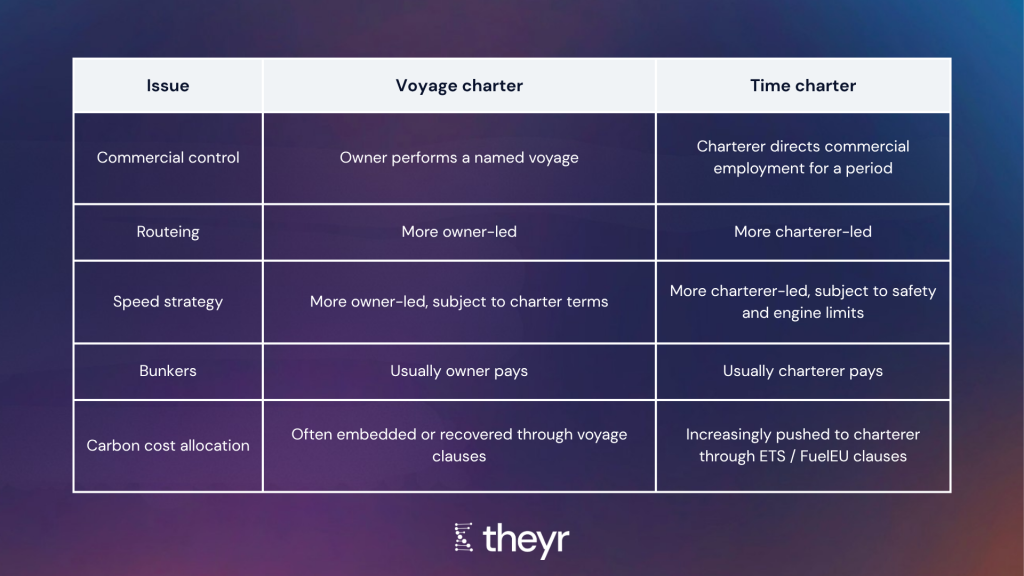
Voyage charter vs time charter: who controls the route?
Under a voyage charter, the owner is responsible for performing the agreed cargo movement. The charterer is buying transport from A to B, not the freedom to reposition the vessel or redesign her trading pattern. Under a time charter, the charterer gains far more control over commercial employment: where the ship trades, which ports she calls and how the schedule is sequenced. Even then, the master retains responsibility for navigation and safety, so commercial orders are not unlimited.
That difference is commercially significant. On voyage business, routing decisions are typically judged against the owner’s margin and the need to perform within the charter-party framework. Under time-charter employment, routing becomes part of trading strategy: ballast optimisation, congestion avoidance, berth timing, next employment and whether an early arrival is commercially worthwhile.
Voyage charter vs time charter: who sets the speed?
Speed follows control. BIMCO’s slow-steaming and CII clauses make the split clear. In voyage charter structures, owner-led speed adjustment is the starting point: BIMCO’s voyage slow-steaming clause and CII voyage clause are built around the owner or master reducing speed, RPM or adjusting course within agreed limits. In time charter structures, BIMCO’s slow-steaming clause expressly allows charterers to instruct reduced speed or adjusted RPM, while the CII Operations Clause recognises that charterers’ employment decisions materially affect carbon intensity and therefore require cooperation between the parties.
That is why just-in-time arrival is now a commercial discipline rather than a nice-to-have. A time charterer can slow down to meet a berth window and avoid burning fuel only to sit at anchorage on hire. On voyage business, the commercial pressure is different: the owner is balancing fuel burn, reasonable dispatch and the risk of drifting into NOR, laytime or demurrage arguments.
Voyage charter vs time charter: who pays for fuel?
Bunker responsibility is simpler. BIMCO notes that under a voyage charter the owner provides and pays for the fuel, prices that cost into the freight and then carries the difference between estimated and actual consumption. Under a time charter, the charterer pays for fuel during the charter period, typically taking over bunkers on delivery and settling remaining bunkers again on redelivery.
So, if weather deteriorates, a route lengthens or the commercial programme adds an unnecessary extra knot, the pain lands in different places. Under voyage business it erodes owner margin. Under time-charter business it hits the charterer’s operating economics straight away. That is why speed, weather and fuel can never be analysed separately from charter structure.
Voyage charter vs time charter: how does delay exposure change?
Delay exposes the same split. In voyage charters, disputes usually revolve around NOR, laytime and demurrage. In time charters, the key commercial questions are hire and off-hire: unless the vessel falls off-hire under the contract, the clock may continue running while the ship waits. That is why congestion, poor sequencing and missed arrival windows can be much more expensive under time-charter employment than they first appear.
Voyage charter vs time charter: who carries compliance risk?
IMO’s carbon intensity regime has applied since January 2023 to vessels above 5,000 GT. Ships receive annual CII ratings from A to E, and vessels rated D for three consecutive years or E once must implement corrective action plans.
Operational choices now directly influence compliance exposure. Speed, waiting time, congestion and voyage profile are no longer just operational variables. They are compliance variables too.
EU regulation deepens that exposure further. The EU ETS has applied to maritime transport since 2024, with surrender obligations phased in at 40% of reported emissions for 2024, 70% for 2025 and 100% from 2026 onward. The system is route-based: 100% of emissions on intra-EU voyages and in-port activity, and 50% on voyages between EU and non-EU ports.
Contractually, the market is already reallocating that cost. BIMCO’s ETS clause for time charters follows the principle that the party paying for the fuel should also provide and pay for the allowances, while owners monitor emissions and provide the data. For voyage charters, BIMCO has published separate ETS clauses, so costs or actual allowances can be transferred, reimbursed or built into freight depending on the agreed structure. BIMCO’s FuelEU clause for time charters also ties charter-period fuel choices and operational decisions to the vessel’s compliance balance and any resulting surcharge exposure.
Where T.VOS fits
This is where T.VOS excels, because the real commercial challenge is not understanding the legal definition of a voyage charter or time charter. It is understanding, early enough, how a routing or speed decision changes fuel cost, ETA, charter-party performance and compliance exposure under the specific charter structure in play.
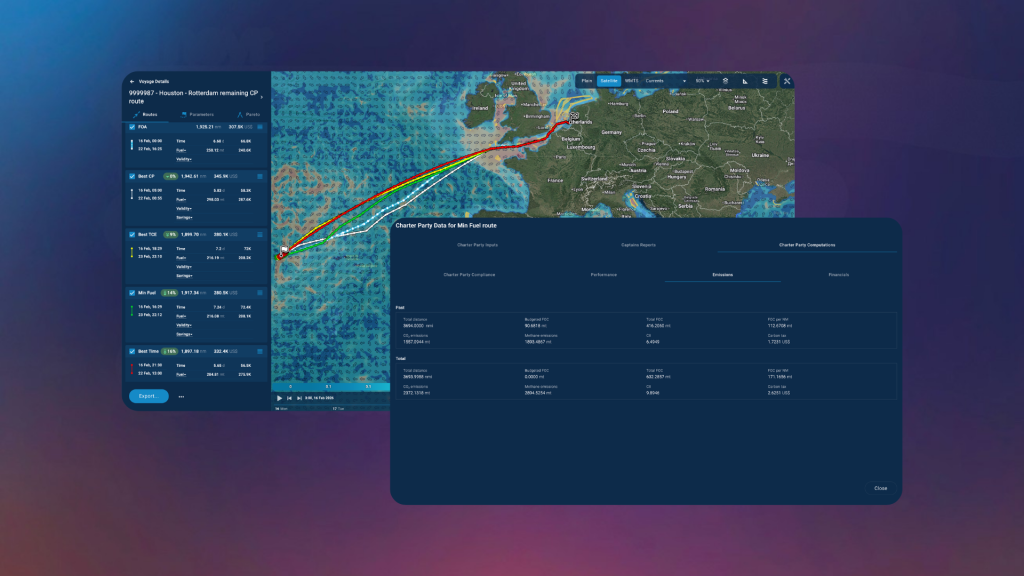
Theyr’s Dynamic Charter Party Module brings charter-party terms, guaranteed speed and fuel consumption, weather exclusions and financial clauses directly into T.VOS’s multi-objective calculations. Instead of leaving performance or consumption claims to post-voyage reconciliation, the platform evaluates those charter-party implications alongside fuel efficiency, transit time, just-in-time arrival, TCE and emissions performance during planning and execution.
In practice, that means users can compare owner-optimised and charterer-optimised routes, monitor actual versus contracted fuel and time performance, quantify weather-related performance treatment, and see projected end-of-voyage outcomes updating through the voyage. Across the wider platform, T.VOS can calculate more than 300,000 voyage options simultaneously and optimise for objectives such as minimum fuel, best time, just-in-time arrival, best TCE, CII and dynamic charter compliance.
A voyage charter changes who owns the voyage economics. A time charter changes who controls the operating levers. T.VOS helps both sides see those trade-offs early enough to act.
Frequently Asked Questions (FAQs)
Which charter type gives the charterer more operational control?
A time charter does. BIMCO describes time chartering as giving charterers substantial control over the vessel’s commercial operation, even though the master still has to refuse unsafe or illegitimate orders.
Who pays for bunkers under a voyage charter?
Usually the owner. Under time charter, the charterer typically pays for bunkers and settles quantities on delivery and redelivery.
Who pays EU ETS costs under a time charter?
The regulated entity still has to surrender the allowances, but BIMCO’s time-charter ETS clause is built so the charterer provides the corresponding allowances because it is the party paying for the fuel and directing commercial employment.
Does FuelEU Maritime change the voyage charter vs time charter decision?
It does not change the basic charter structures, but it makes operational control more valuable and more risky. FuelEU Maritime has applied since 1 January 2025 and BIMCO’s time-charter clause specifically addresses how charter-period operations affect the vessel’s compliance balance and related surcharge exposure.