
Table of Contents
Voyage planning software and voyage optimisation software are often treated as interchangeable terms. They are not.
Voyage planning software helps crews and shore teams build a safe, compliant berth-to-berth passage plan before departure. Voyage optimisation software takes over once the voyage is underway, continuously reassessing whether the chosen route, speed and operating profile still make commercial and operational sense.
Put simply: voyage planning software creates the plan. Voyage optimisation software keeps improving it. That distinction matters because many operators already have capable planning tools in place, yet still rely on fragmented decision-making once weather, vessel performance, berth availability, emissions exposure and charter obligations begin to shift.
What voyage planning software is built to do
At its core, voyage planning software exists to help bridge and shore teams prepare voyages safely and consistently.
That includes:
- Building berth-to-berth routes
- Managing waypoints and passage plans
- Supporting navigational compliance
- Sharing voyage data between ship and shore
- Maintaining auditable documentation
- Performing checks for under-keel clearance, air draught and regulatory restrictions
This remains essential. No operator wants crews assembling passage plans from disconnected charts, spreadsheets and email chains. Strong voyage planning software reduces manual workload, improves consistency and helps demonstrate compliance with navigational and regulatory requirements.
The best systems are valued for route creation, ETA calculation, route exchange, checklist management and ship-to-shore coordination. In short, voyage planning software is about readiness. It ensures the vessel departs with a structured, compliant and operationally sound plan. The real question is what happens after departure.
What voyage optimisation software is built to do
Voyage optimisation software exists because static plans rarely survive contact with reality. Its purpose is not simply to validate a route before sailing, but to continuously improve route and speed decisions as conditions evolve throughout the voyage.
Weather systems shift. Currents change. Fuel performance drifts away from assumptions. Berth windows tighten or move. Charter party exposure increases. A route that looked commercially sensible on Monday may be the wrong answer by Wednesday. This is where voyage optimisation software becomes a separate category.
Rather than producing a fixed plan, optimisation platforms continuously recalculate trade-offs using live or near-real-time inputs such as:
- Weather and metocean data
- Vessel performance behaviour
- Speed and power curves
- ETA requirements
- Emissions exposure
- Charter party terms
- Commercial priorities
The output is not simply a route on paper. It is live decision support while the voyage is still underway. Anyone who has watched a vessel burn fuel to meet an ETA only to anchor outside port for twelve hours understands the cost of static planning. Optimisation exists to prevent that waste before it appears in the post-voyage report.
Voyage planning software vs voyage optimisation software: a quick comparison
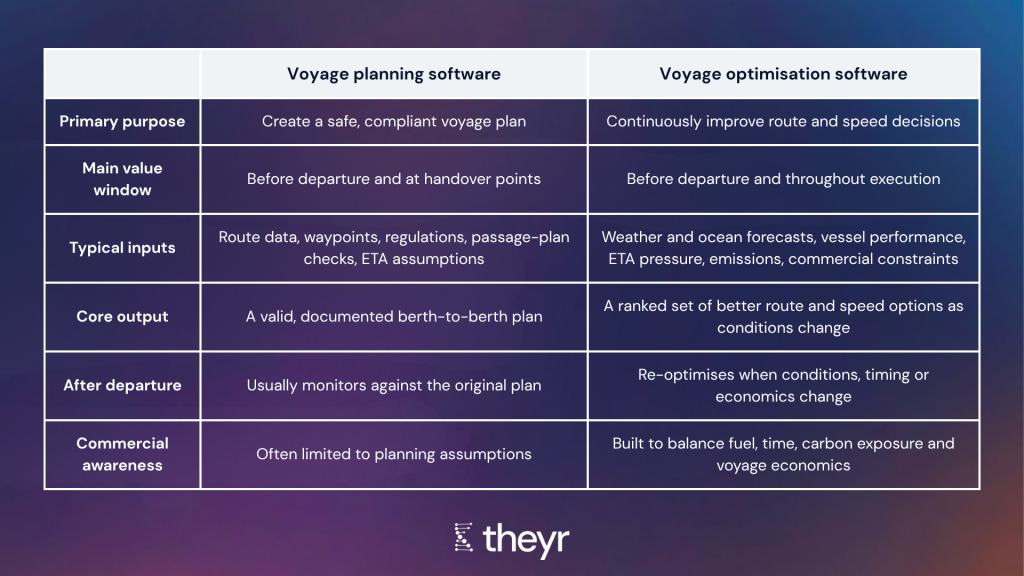
Voyage planning software vs voyage optimisation software: the practical difference
The simplest distinction is this:
- Voyage planning software helps you prepare the voyage properly
- Voyage optimisation software helps you run the voyage better
That difference changes the value proposition entirely.
Planning software is primarily focused on navigational discipline, safety and compliance. Optimisation software is focused on dynamic performance and commercial outcomes under changing conditions.
The operational questions are different:
- Are we still on the right speed profile?
- Should we slow steam for just-in-time arrival?
- Are we protecting TCE or quietly eroding it?
- Has the weather forecast changed enough to justify rerouting?
- Are emissions costs beginning to outweigh schedule gains?
Those are not traditional passage-planning questions. They are voyage optimisation decisions.
Why the distinction matters more now
Modern shipping economics have made optimisation far more commercially significant than it was even a few years ago.
CII reporting is now operational reality. FuelEU Maritime is in force. EU ETS exposure continues to expand. At the same time, berth congestion, charter scrutiny and fuel volatility remain persistent operational pressures.
That means route quality, timing and speed selection now have a direct impact on:
- Fuel spend
- Emissions exposure
- Schedule reliability
- Charter party compliance
- Margin protection
Just-in-time arrival is a perfect example. Industry and IMO-backed initiatives increasingly emphasise matching vessel speed to berth and service availability, rather than rushing to port only to wait at anchor.
That is not a static planning problem. It is a live optimisation problem. The weakness of purely static voyage planning tools is that they help teams create a solid plan, but often provide limited support once real-world conditions begin deviating from assumptions.
When weather shifts, berth slots move, fuel curves deteriorate or charter exposure appears, the real value lies in recalculating trade-offs quickly and transparently. That is where voyage optimisation software earns its place.
What a multi-objectibe voyage optimisation software should do
Modern voyage optimisation is not simply weather routing with better branding. Nor is it a one-dimensional fuel calculator. Shipping decisions rarely optimisearound a single objective. The lowest-fuel route may not protect schedule. The fastest route may damage TCE. The best ETA route may increase carbon exposure.
That is why leading platforms are moving towards multi-objective optimisation. Rather than pretending there is one universally “best” route, stronger systems expose the trade-offs between competing priorities, allowing operators to make informed commercial decisions.
That matters because operators do not just need recommendations. They need visibility into what is being gained, what is being sacrificed, and why. For buyers, that becomes an important test. If a platform only optimises one metric at a time while hiding the wider consequences inside a black box, it may improve one KPI while quietly damaging another. The better platforms make those tensions explicit.
Where T.VOS fits
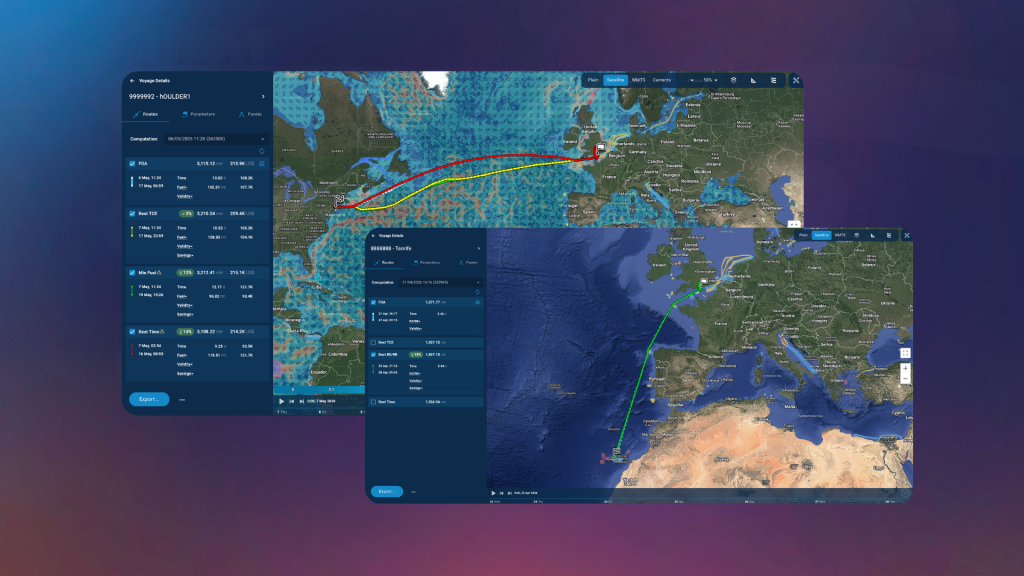
T.VOS is not another digital passage-planning checklist. It is a multi-objective voyage optimisation engine designed to sit beyond static planning and continuously improve voyage performance as conditions evolve. T.VOS can calculate more than 300,000 voyage options in a single computation while optimising across multiple objectives including:
- Minimum fuel consumption
- Best transit time
- Just-in-time arrival
- Time charter equivalent (TCE)
- Charter party compliance
- CII-related outcomes
The platform is designed to integrate through APIs with metocean data, navigational databases and hydrodynamic vessel models, making it suitable for operators and software providers that want optimisation capability without replacing existing systems.
That positioning matters because most fleets do not need to replace their voyage planning software. What they need is an optimisation layer that works alongside existing planning workflows while adding the live commercial decision support those systems often lack.
T.VOS also creates a stronger commercial story than generic route efficiency messaging alone. Its Dynamic Charter Party Module incorporates charter terms, guaranteed speeds, consumption clauses, weather exclusions and financial exposure directly into the optimisation process.
That means routes can be evaluated not only for fuel burn or ETA, but also for potential claims, penalties and avoidable disputes. The same logic applies to emissions performance. A route that appears acceptable from a navigational perspective may still create unnecessary carbon exposure or weaken CII outcomes. Optimisation software should surface those consequences before they become operational reality.
The smarter stack is planning plus optimisation
Modern fleets require two layers:
- Voyage planning software to create and govern a safe, compliant passage plan
- Voyage optimisation software to continuously improve voyage performance after departure
But the modern stack is increasingly two-layered. First, you need voyage planning software to build and govern a sound passage plan. Second, you need voyage optimisation software to keep improving the voyage once weather, performance, berth readiness and commercial pressures start moving.
If the platform can recalculate route and speed decisions against live weather, vessel behaviour, ETA pressure, charter terms and emissions exposure, you are in voyage optimisation software territory.
That is why the terms should not be treated as interchangeable. Voyage planning software keeps voyages safe, documented and compliant. Voyage optimisationsoftware is where fleets protect margin, improve schedule integrity and make better decisions when the voyage stops behaving like the plan.
Book a demo of T.VOS to see how it can integrate alongside your existing voyage planning software and turn static planning into dynamic performance.
Frequently Asked Questions (FAQs)
What is the difference between voyage planning software and voyage optimisation software?
Voyage planning software is designed to create a safe, compliant passage plan before departure. Voyage optimisation software keeps improving route and speed decisions as conditions change during the voyage, balancing factors such as fuel, ETA, emissions and commercial performance.
Does voyage optimisation software replace passage planning?
No. Passage planning remains essential. In practice, the strongest operating model is voyage planning software for navigational discipline and compliance, paired with voyage optimisation software for live decision support during execution.
Can voyage planning software reduce fuel use on its own?
Yes, but only up to a point. Better route preparation and clearer ETA planning can improve efficiency, but larger gains often come from re-optimising route and speed once weather, berth timing, vessel performance and commercial constraints start to change.
How does T.VOS fit into an existing software stack?
T.VOS is best positioned as an optimisation layer rather than a replacement for planning tools. It can sit alongside existing voyage planning workflows and add multi-objective optimisation for fuel, time, just-in-time arrival, charter party outcomes and CII-related performance.